SaaS GEO Strategy: How to Get Your Product Recommended by ChatGPT and AI Overviews
 Kamaraj Mathiarasan (Kim)
Last updated on
A SaaS GEO strategy is a plan for getting your product named and recommended when buyers ask ChatGPT, Perplexity or Google’s AI Overviews which tools to shortlist.
Think about how a lot of buyers shortlist software now. They ask ChatGPT which tools to look at, get four names back, and book demos with those four. So if you’re not on that list, you might never hear about the deal at all. In the programs we run, the brands that get named do their SEO in a deliberate order, starting from the questions their buyers actually ask. I’ve written this guide with B2B SaaS marketing leaders, SEO leads and founders in mind, the people who already run SEO and now have to show what AI search is worth.
The 6-Step SaaS GEO Strategy at a Glance
- Baseline your buyer questions: Run 20 to 30 real buyer prompts in ChatGPT, Perplexity, Gemini and AI Overviews, and note where you’re named, recommended or missing.
- Make your site readable to AI: Let AI crawlers through robots.txt and your CDN, keep content in the HTML, and add SoftwareApplication and Organization schema.
- Rewrite your BoFu comparison and pricing pages for AI: Make your comparison, alternatives, pricing and use-case pages answer-first, starting with the prompts closest to a purchase.
- Optimize your ToFu and MoFu pages for AI: Make your how-to guides, problem explainers and category pages answer-first too, so AI quotes you while buyers are still researching.
- Earn third-party proof: Get reviewed on G2 and Capterra, listed in the roundups AI already cites, and mentioned genuinely in the Reddit threads your buyers read.
- Measure shortlist share and pipeline: Track how often AI recommends you for your buyer prompts, split AI traffic by platform in GA4, and report the pipeline it brings.
What Is a SaaS GEO Strategy?
A SaaS GEO strategy means choosing the buyer questions you want AI tools to name you for, then building the pages, technical setup and third-party proof that get you named and recommended in those answers.
The word I’d hold on to there is “recommended.” Showing up in an AI answer can mean two very different things. Sometimes the answer puts you on the shortlist and gives a reason, like “best for teams that need X.” Other times you’re just a source it quoted while recommending someone else. Both count as visibility on a dashboard, but only the first one gets you a demo.
So when I talk about a GEO strategy, I mean a plan to raise your shortlist share: how many of your buyers’ real questions end with AI suggesting you.
You’ll also hear this called answer engine optimization, or AEO. In practice the work is the same, so this guide covers both.
How Is a GEO Strategy Different From Your SEO Strategy?
A GEO strategy aims to get your product named inside the answer an AI tool writes, whereas an SEO strategy aims to rank your pages in Google’s results, so GEO also has to win on pages you don’t own.
Here’s how I’d put the two next to each other:
| SEO strategy | GEO strategy | |
|---|---|---|
| What you’re aiming for | Your pages ranking for the searches buyers type in search engines | Your product named and recommended in AI answers from ChatGPT, Claude, Google’s AI Overviews and the rest |
| What you measure | Rankings, organic clicks and organic pipeline | Shortlist share across your buyer prompts, AI-referred visits and pipeline |
| Where you win | Your site, plus the review sites, roundups and threads | Mostly the same |
| What they share | Crawlable pages, answer-first content and authority | The same, which is why GEO runs inside your SEO program |
That last row matters for how much effort you give each one. Across the 53 B2B SaaS brands we analyzed over eight months, organic search still sent 91.3% of traffic and AI tools sent 8.7%. So I’d treat GEO as a slice of your SEO work, with its own targets, rather than a second program.
What Tools Do You Need for a SaaS GEO Strategy?
Most of a SaaS GEO strategy runs on free reports from Google, Bing and GA4 plus your CRM, and a paid AI visibility tracker only earns its place once you’re checking more than a handful of prompts every month.
This is what I’d use, in the order the steps need it (prices checked in November 2026):
| Tool | Pricing | Helps you to | Alternatives |
|---|---|---|---|
| Google Search Console, Generative AI report | Free (still rolling out) | See which pages get impressions in AI Overviews and AI Mode | No alternative to Google’s own data |
| Bing Webmaster Tools, AI Performance report | Free | See how often Copilot and Bing’s AI answers cite your pages, and for which queries | No alternative to Bing’s own data |
| Google Analytics 4 | Free | Split AI-referred visits by platform with a custom channel group | Your current analytics tool |
| Your CRM (HubSpot or Salesforce) | Paid | Add “an AI assistant” to “How did you hear about us?” and tie AI visits to pipeline | A form field in your marketing automation tool |
| Rich Results Test | Free | Check your SoftwareApplication and Organization schema | Schema Markup Validator |
| Otterly.AI | From $29/mo for 15 prompts, free trial | Track a small prompt set in ChatGPT, AI Overviews, Perplexity and Copilot | Peec AI, from $95/mo for 50 prompts |
| Semrush AI Visibility Toolkit | $99/mo | Track prompts, share of voice and how AI positions you against competitors | Ahrefs Brand Radar, an add-on to paid Ahrefs plans |
| Profound | Custom pricing, free 7-day trial | Track hundreds of prompts daily across up to nine AI engines | Scrunch |
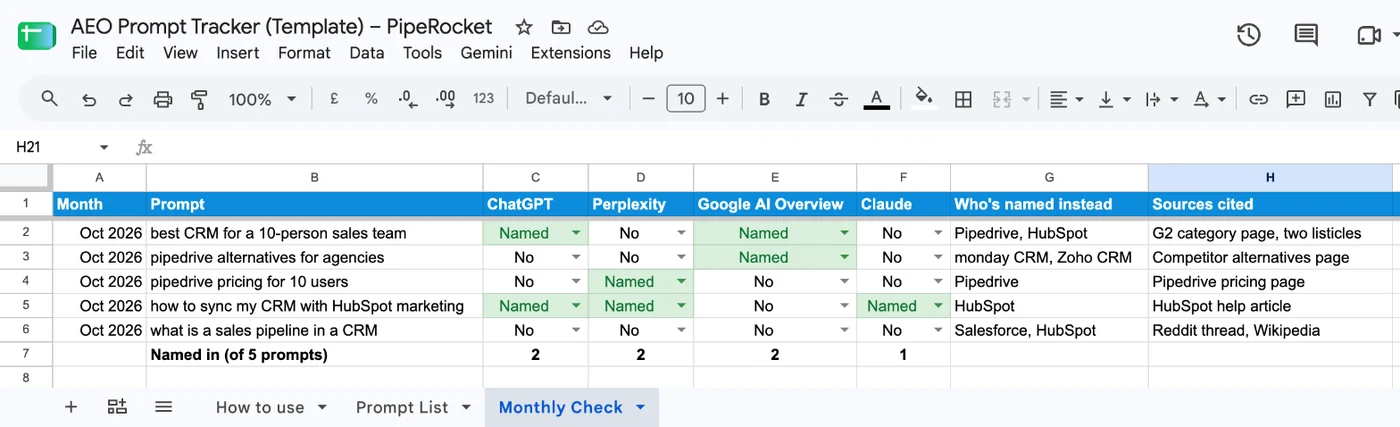
If you’re just starting, the free rows are enough for your first baseline. A spreadsheet does the prompt tracking fine at 20 or 30 prompts, and we’ve built an AEO prompt tracker template you can copy for exactly that. I’d only pay for a tracker once you’re re-running the same set every month and want the trend without doing it by hand.
Here’s what the template looks like once you’ve filled in a few prompts. Each row is a buyer question, each column is an AI tool, and the last columns note who got named instead of you and which sources the answer cited:
How to Build a SaaS GEO Strategy in 6 Steps
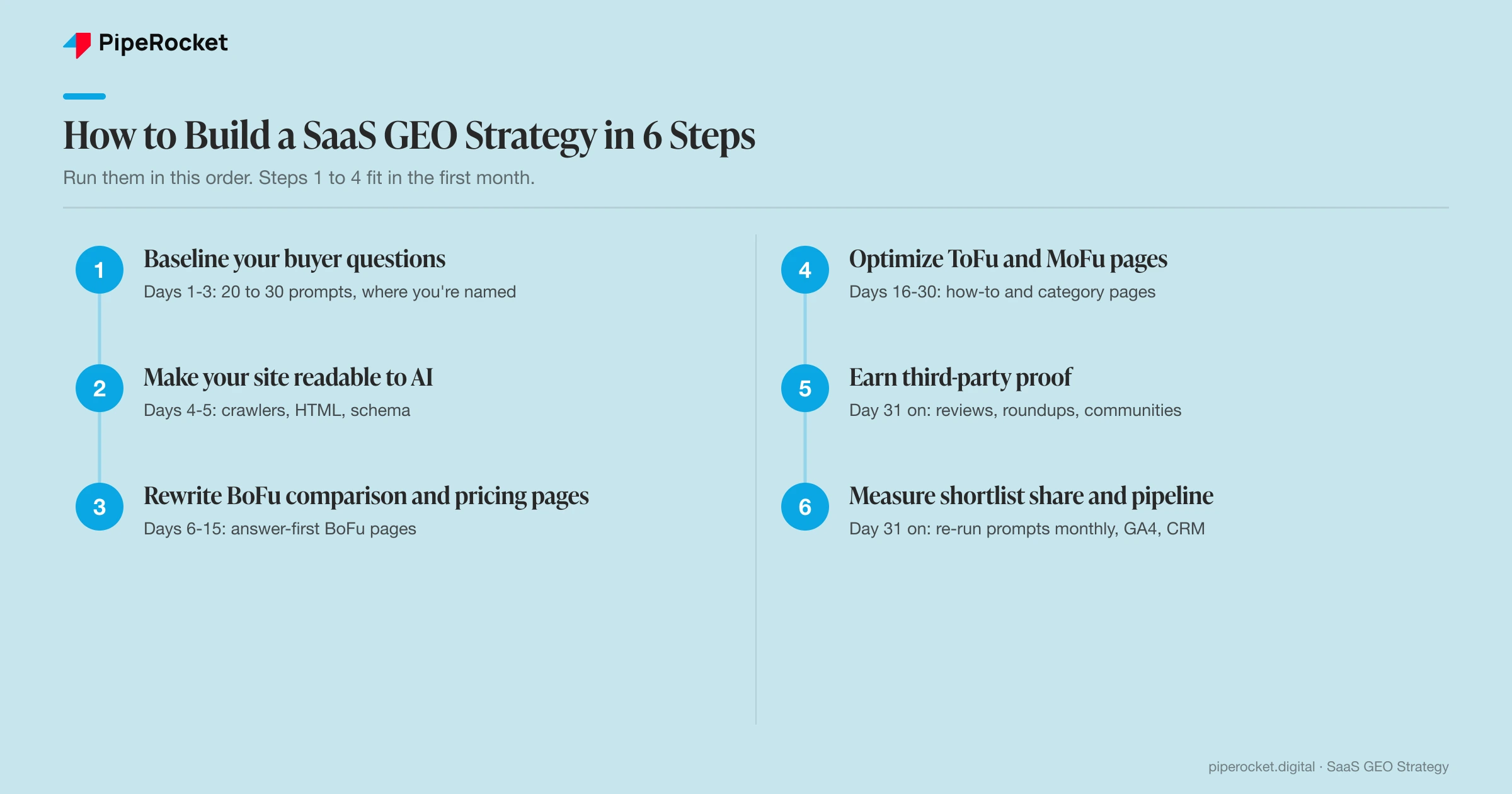
To build a SaaS GEO strategy, baseline your buyer questions, make your site readable to AI, rewrite your comparison and pricing pages, optimize your ToFu and MoFu pages, earn third-party proof, and measure shortlist share and pipeline, in that order.
The order is what turns this from a list of tactics into a plan. Each step gives you what the next one needs. You can’t decide which pages to fix until you know which questions you’re losing, and there’s no point earning mentions for pages AI can’t read. The timings in each heading are how we’d lay out the first 90 days. Steps 1 to 4 fit in the first month, and Steps 5 and 6 run from day 31 onward.
Step 1: Baseline Your Buyer Questions (Days 1 to 3)
Write down 20 to 30 questions your buyers would actually type into ChatGPT, run each one in the AI tools they use, and record where you show up before you change anything.
Start with the questions closest to a purchase, because those are the answers that turn into shortlists:
- “best [category] software for a 200-person company”
- “[competitor] alternatives for [a specific need]”
- “[your brand] vs [competitor]”
- “how much does [category] cost”
Then add a few problem questions from earlier in the research, like “how do I [job your product does].” Sales calls and support tickets are the best place to find the exact wording. Add a couple of versions of each question too, because AI tools often split one question into several searches behind the scenes, which is called query fan-out.
Run every question in each AI tool your buyers use: ChatGPT, Perplexity, Gemini, Claude, Microsoft Copilot, and Google’s AI Overviews and AI Mode. In ChatGPT, use a temporary chat, because your own logged-in history can nudge the answer in your favor. For each answer, write down four things:
| What to record | Why it matters |
|---|---|
| Were you named? | Tells you which questions you’re invisible on |
| Were you recommended with a reason, or only mentioned? | Only a recommendation gets you on the shortlist |
| Who was named instead of you? | These are the competitors AI trusts more for that question |
| Which sources did the answer cite? | These pages become your list for Steps 3 and 5 |
That last column is where most of the strategy comes from. If an AI answer keeps citing the same two roundups and a G2 category page, you now know exactly where you need to show up.
Step 2: Make Your Site Readable to AI (Days 4 to 5)
Make sure AI crawlers can reach your key pages, that the content is in the HTML they receive, and that your schema tells them clearly what your product is and who it’s for.
This is the dull part, and it’s also where I’d expect the biggest surprises. Most teams check robots.txt for AI crawlers, see that GPTBot isn’t blocked, and move on. But AI crawlers can be turned away further up the chain, by a CDN or firewall rule someone switched on years ago. Cloudflare, for one, started blocking AI crawlers by default for new sites in 2025. Your browser tests all pass, because you’re a person and not a bot, so nobody notices.
So test your homepage, pricing, product and comparison pages the way a crawler sees them, and check what your CDN does with GPTBot, OAI-SearchBot, ClaudeBot and PerplexityBot.
Here’s what a robots.txt looks like when it lets the main AI crawlers in:
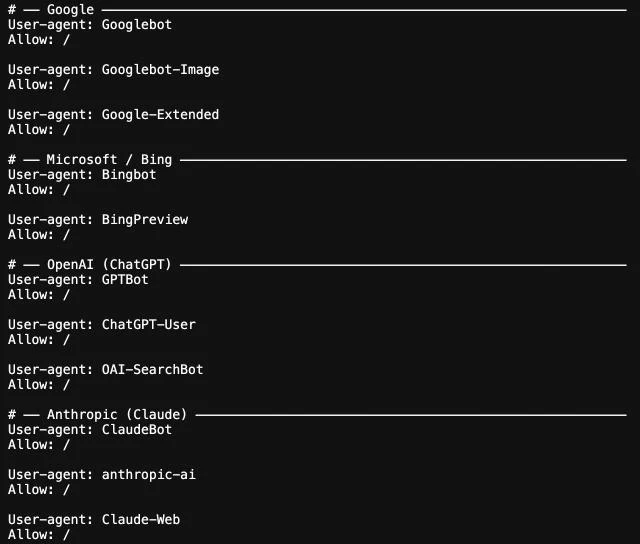
Then check three things on those same pages:
- Content in the HTML: if your pricing table or feature list only appears after JavaScript runs, several AI crawlers never see it, because they don’t run JavaScript.
- A plain summary up top: open each product page with 40 to 60 words that say what the product does and who it’s for, in the words your buyers use.
- Schema that names you: add Organization schema as JSON-LD with
sameAslinks to your G2, LinkedIn and Crunchbase profiles, and SoftwareApplication schema with your category and pricing on product pages.
The aim of all three is that every page, profile and listing describes you the same way, which is what people mean by entity clarity, so an AI tool doesn’t have to guess which version is true. An llms.txt file is optional on top of this, and I wouldn’t spend more than 10 minutes on it.
Step 3: Rewrite Your BoFu Comparison and Pricing Pages for AI (Days 6 to 15)
Rewrite your bottom-of-funnel (BoFu) pages, the comparison, alternatives, pricing and use-case pages buyers read right before they choose, so the answer to each buyer question sits in the first lines where AI can lift it.
When an AI tool builds a shortlist, it’s mostly reading vendor pages, yours and your competitors’. If you don’t publish a “[you] vs [competitor]” page, it reads your competitor’s version of that comparison. These are the BoFu pages I’d fix first.
Comparison and Alternatives Pages
Write a comparison page and an alternatives page for each real competitor, with a straight verdict near the top and the specifics you judged them on. ClickUp’s “ClickUp vs. Asana” page is a good example. It has a section literally labeled “The verdict” (1), then four reasons, each naming the exact plans and limits that differ (2). That’s the kind of line an AI answer can lift word for word:
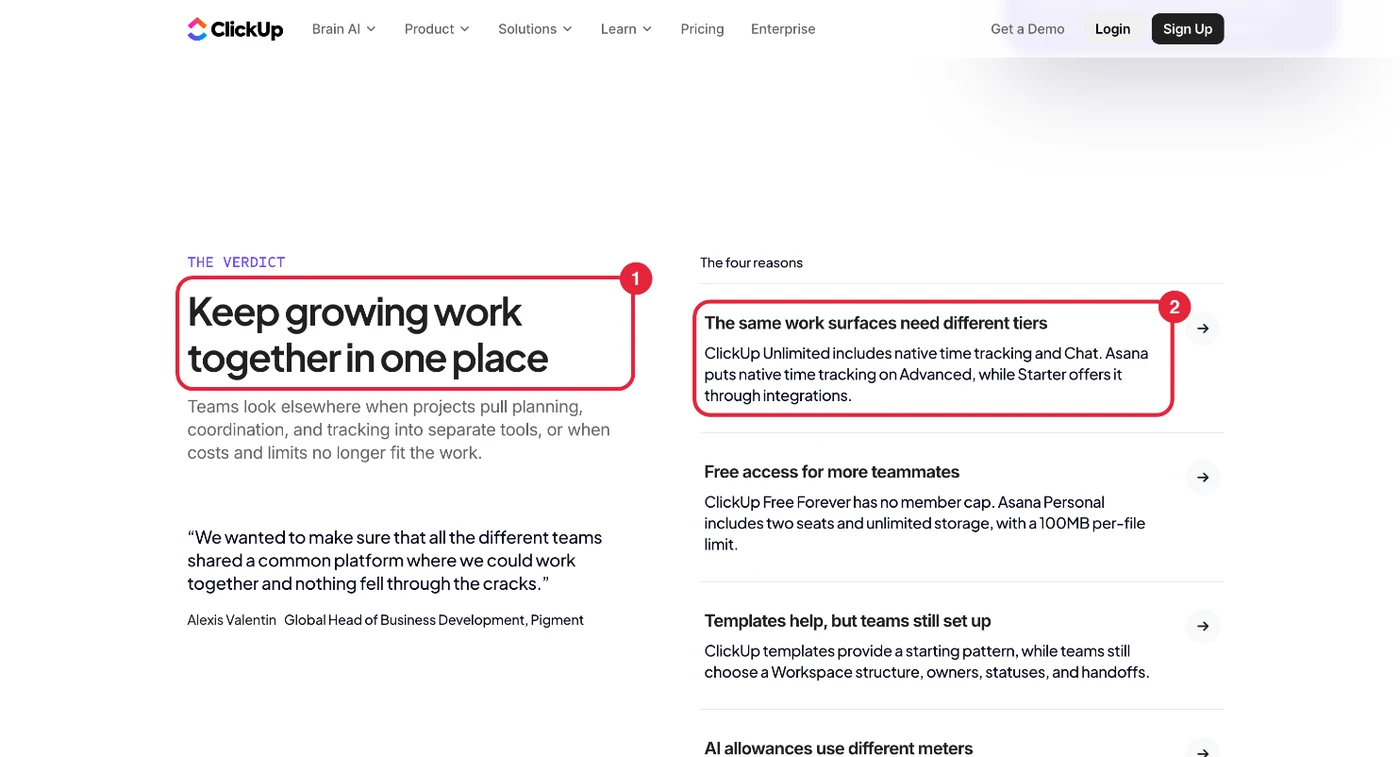
Pricing Pages
Put your prices in plain text. Asana’s pricing page lists every paid plan with a number and what it’s per, like “US$10.99, per user, per month billed annually.” When a buyer asks an AI tool what Asana costs, that’s the line it can quote. If your page only says “contact sales,” the answer tends to name a competitor that does show numbers.
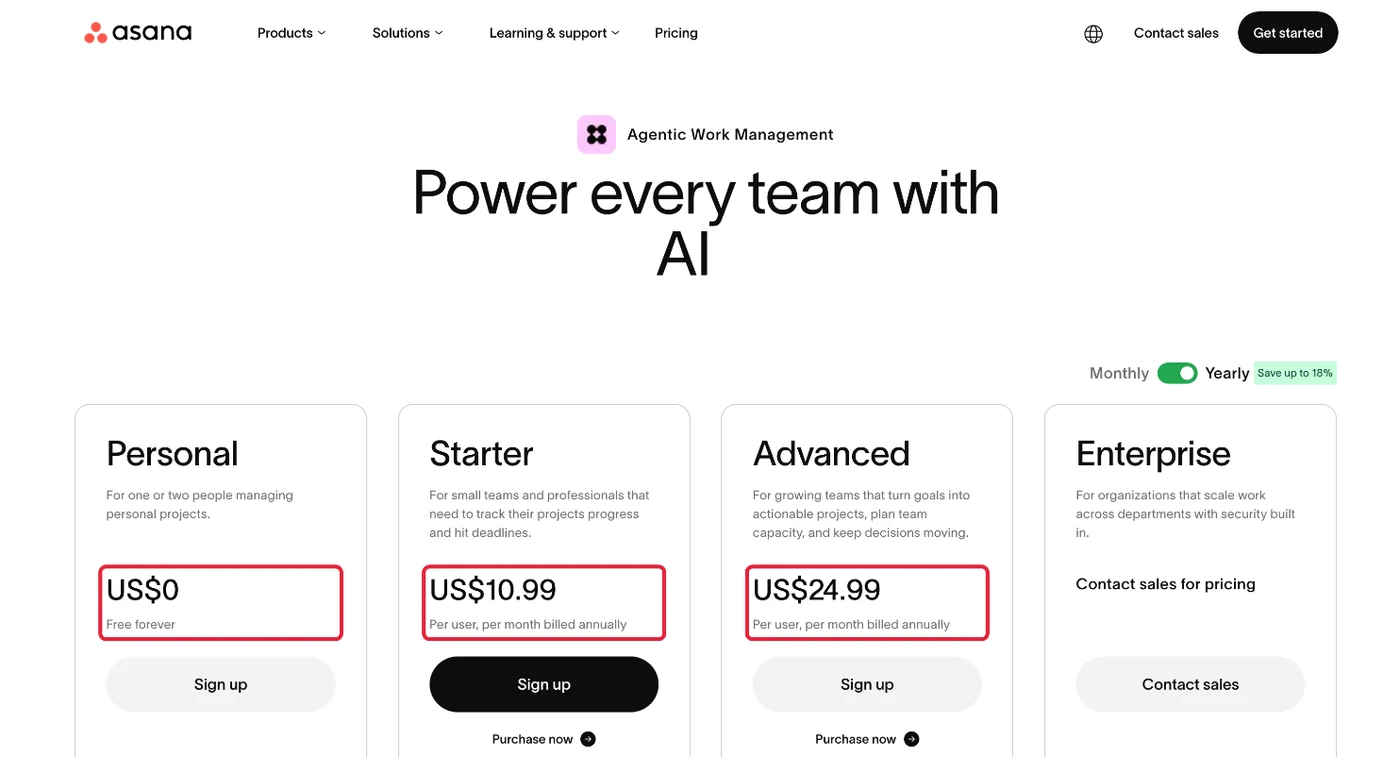
Use-Case and Industry Pages
Build one page per buyer type, each answering “is this right for a company like mine?” Pipedrive has a page called “Real estate sales CRM,” and the first lines tell a real estate team exactly what it does for them: pipelines for properties, investors and buyers. So when someone asks an AI tool for a CRM for real estate, there’s a page that answers that exact question:
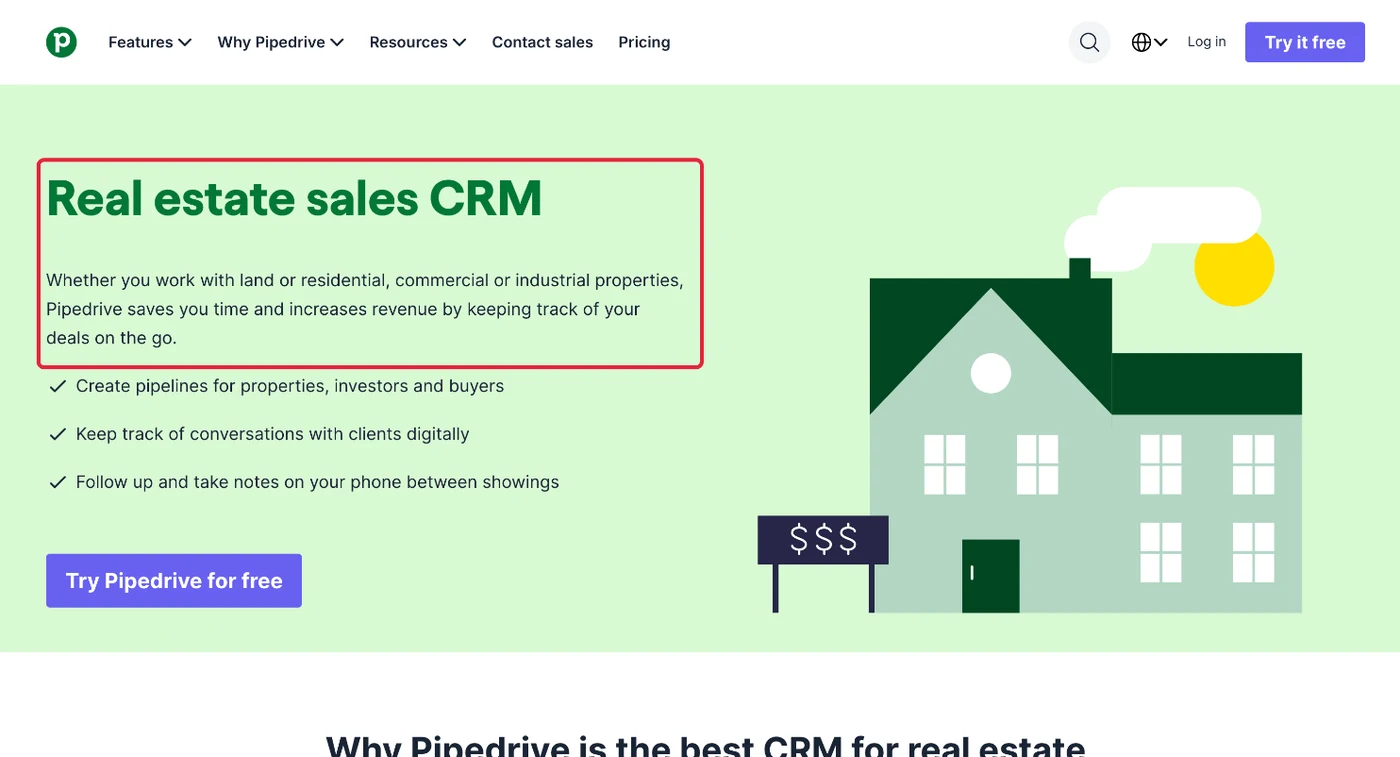
Proof Pages
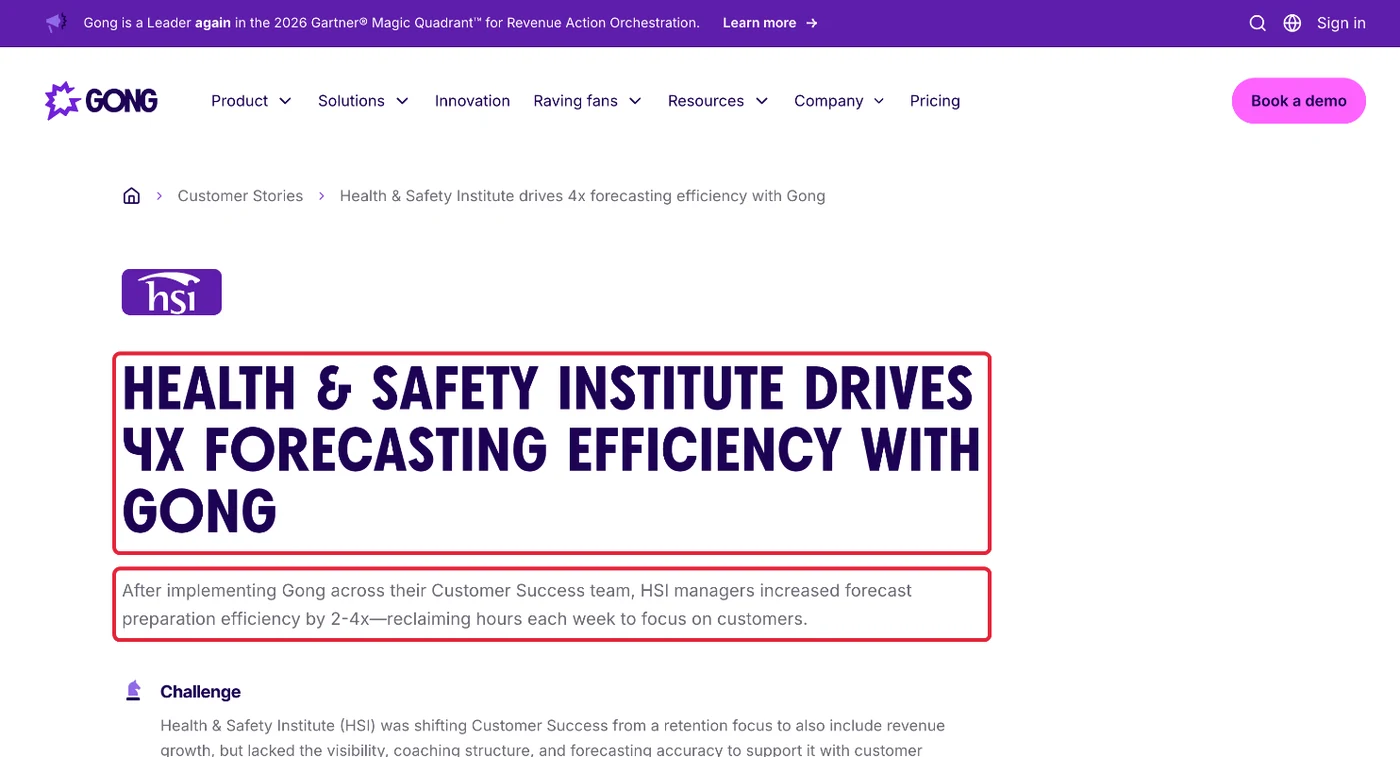
Publish case studies with real numbers and named customers, because AI looks for evidence it can repeat, the same first-hand proof Google looks for under E-E-A-T. Gong’s Health & Safety Institute story puts the result in the headline, “4x forecasting efficiency,” and backs it up straight away with “2-4x” in the first lines. Compare that with a quote like “they love our platform,” which gives an AI answer nothing to repeat:
You won’t have time for everything at once, so score each piece of work on three things before it goes on the roadmap. How close is it to a buying decision? How much effort is it? And how long will the result last before it needs redoing?
| Work | Close to a purchase? | Effort | How long it lasts | Do it |
|---|---|---|---|---|
| Rewriting existing comparison pages answer-first | Very close | Low | Long | Now |
| Publishing pricing in plain text | Very close | Low | Until prices change | Now |
| New alternatives pages for your top 3 competitors | Very close | Medium | Long | This quarter |
| Use-case pages for each buyer type | Close | Medium | Long | This quarter |
| Answering broad “what is” questions | Far | Medium | Short | Later, in Step 4 |
Score five candidate pieces of work this way and the order usually names itself, because one or two will clearly beat the rest on how close they sit to a purchase.
Step 4: Optimize Your ToFu and MoFu Pages for AI (Days 16 to 30)
Once your buying-decision pages are answer-first, give your how-to guides, problem explainers and category pages the same treatment, so AI quotes you while buyers are still working out what they need.
On each of those pages:
- Put the answer under the heading: open each section with one or two sentences that answer its question on their own.
- Use your own data where you have it: a benchmark, a survey result or a number from your product gives AI something to quote that nobody else has.
- Tie the answer to your category: a guide on reducing churn from a billing tool should explain where billing fits in, so the step from problem to product is right there.
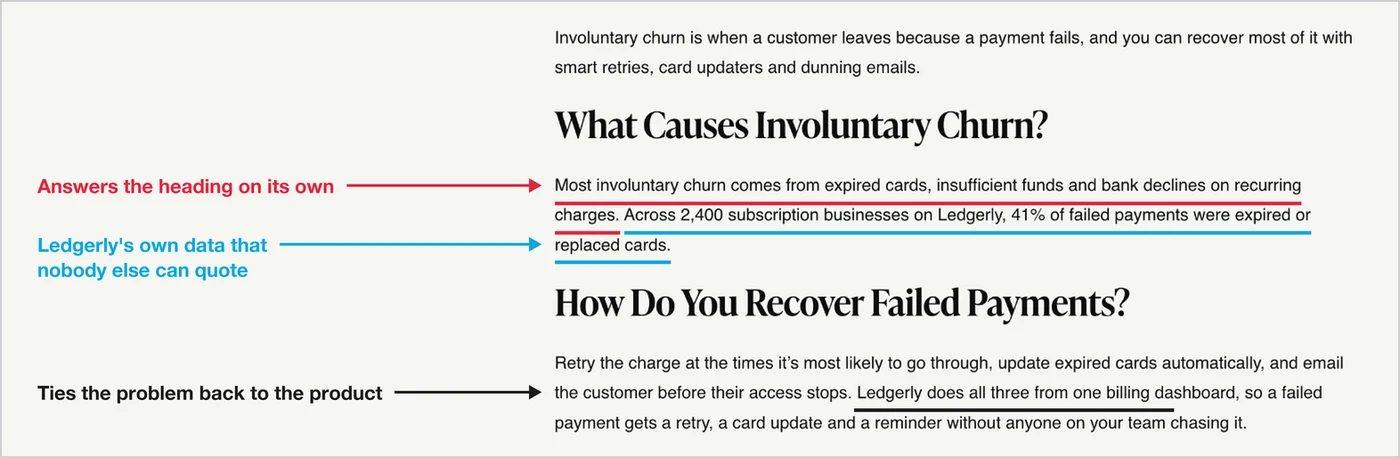
Here’s what that looks like on a ToFu post for a made-up billing tool called Ledgerly. The arrows point to the three things that make it easy for AI to quote:
Keep these below your comparison and pricing pages in the scoring table. They pay off over a longer stretch, through the branded searches and shortlists they lead to later.
Step 5: Earn Third-Party Proof (Day 31 Onward)
Get named on the third-party pages AI already trusts for your buyer questions: review sites, roundups, industry publications and the communities your buyers read.
Your own pages get you quoted, but it’s other people’s pages that make an AI tool confident enough to actually recommend you. The good news is you don’t have to guess which ones matter. Your Step 1 baseline already lists the sources each answer cited, so that list is your target list.
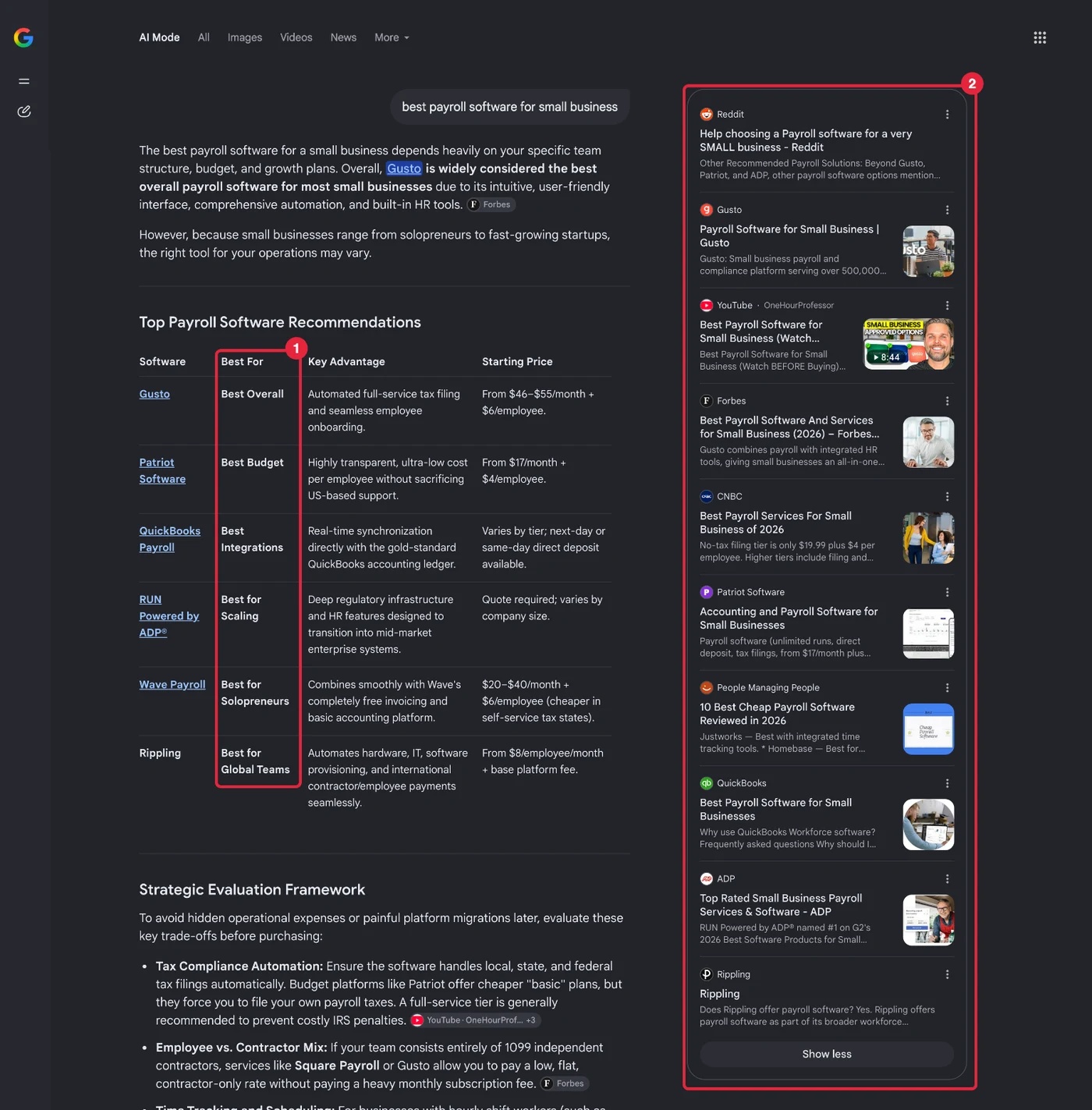
Here’s an example. I asked Google’s AI Mode for the best payroll software for small businesses. Look at how each tool gets a one-line verdict (1), like “Best Overall” or “Best Budget.” Then look at the full list of sources behind the answer once you click “Show all” (2). There’s a Reddit thread, Forbes, CNBC, a review site and a YouTube video, plus the vendors’ own pages from Gusto, Patriot, QuickBooks, ADP and Rippling. The third-party ones are the pages you’d want to be on:
Then work through it:
- Roundups and “best X” lists: pitch the author with a real reason you belong on it, like a use case they missed or a customer type they don’t cover.
- Review sites: keep G2 and Capterra reviews coming in. A profile with four reviews from 2023 tells AI very little about you today.
- Communities: answer questions on Reddit and post short breakdowns on LinkedIn and YouTube, as a person who knows the problem, under your own name.
- Digital PR: put out original data that writers want to quote, because every article that cites it is another source AI can read, and even unlinked brand mentions count.
This is the part of a SaaS GEO strategy that runs alongside everything else and never really ends. Reviews and mentions build up over months, so start early and keep going.
Step 6: Measure Shortlist Share and Pipeline (Day 31 Onward)
Re-run your buyer questions every month to see how often you’re recommended, split AI-referred traffic by platform in GA4, and report the pipeline it brings next to your organic numbers.
Most AI visibility numbers you’ll see are shakier than they look, which makes a SaaS GEO strategy harder to measure than SEO. As I’ve said before:
“Most LLM SEO tracking tools right now? Pure guesswork.” (Kim)
They run synthetic prompts, and AI answers change with the person, the location and the day, so there isn’t one true rank to report. I’d treat any visibility score as a rough direction and measure five things instead:
- The right prompts: are you showing up for the alternatives, comparison and best-tool questions your buyers ask?
- Repeat appearances: one mention is noise, and showing up across 20 to 30 versions of the question is a pattern.
- Your BoFu pages: more direct visits, more branded searches and better results on alternatives pages are easier to believe than “AI sessions up 400%.”
- What sales hears: “I found you in ChatGPT” on a discovery call is a real buyer telling you it worked.
- Pipeline: better inbound, faster trust and buyers who already know your name are the result that matters.
For the numbers themselves, here’s what I’d swap:
| Instead of reporting | Track this | Tools you need |
|---|---|---|
| An AI visibility score | Shortlist share: how many of your buyer questions end with AI recommending you, per engine | A prompt tracker sheet, or Otterly.AI, Peec AI or the Semrush AI Visibility Toolkit |
| Total AI sessions | AI-referred visits split by platform, with a custom channel group for ChatGPT, Perplexity, Gemini, Claude and Copilot | Google Analytics 4 |
| Last-click AI conversions | Leads who answer “an AI assistant” to “How did you hear about us?”, plus branded search and homepage conversions | Your CRM (HubSpot or Salesforce), Google Search Console |
What Does the First 90 Days of a SaaS GEO Strategy Look Like?
The first month of a SaaS GEO strategy goes to a baseline, crawler and schema fixes and rewriting your BoFu, MoFu and ToFu pages, and days 31 to 90 go to third-party proof and measurement, with more prompts where you’re named and more AI-referred visits as the early signs.
Here’s how I’d lay it out:
| When | What you’re doing | What you should see |
|---|---|---|
| Days 1 to 3 | Step 1: write your buyer questions and record where you’re named | A baseline: named, recommended, missing, and who beats you |
| Days 4 to 5 | Step 2: crawler access, content in the HTML, schema and product summaries | Your key pages readable by every AI crawler you care about |
| Days 6 to 15 | Step 3: comparison, alternatives, pricing and use-case pages rewritten | Your pages starting to show up as cited sources for buying questions |
| Days 16 to 30 | Step 4: how-to and problem pages answer-first | Named on more of your buyer questions, more AI-referred visits |
| Days 31 to 90, and onward | Steps 5 and 6: reviews, roundups, PR and monthly re-runs | Shortlist share trending up, AI leads showing in the CRM |
Example: An HR Software Client’s First Quarter of GEO
Here’s a recent example from our own work, for an HR software client:
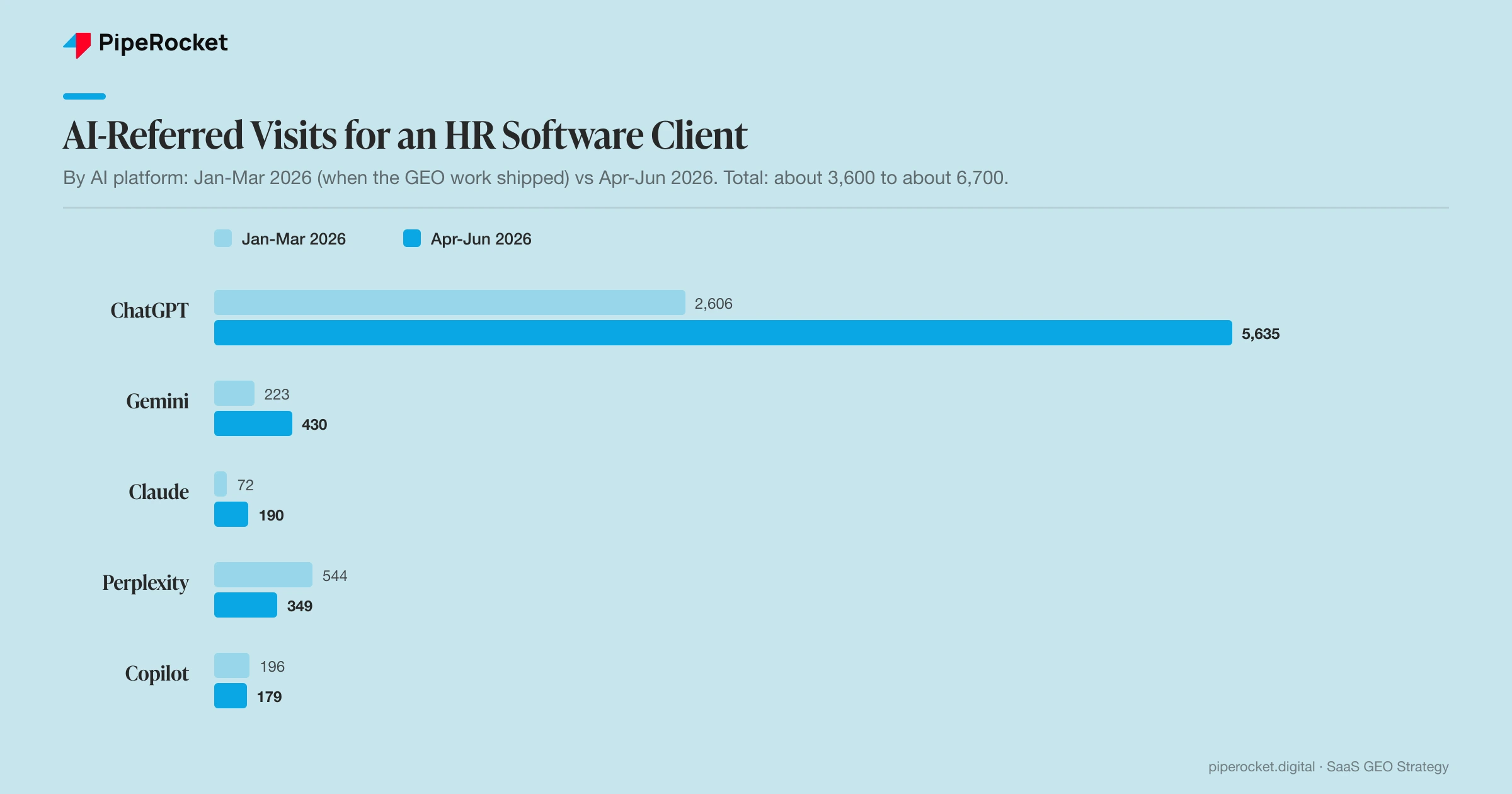
- What we did: in January to March 2026, we optimized 100 of their blog posts for AI answers and opened their site to AI crawlers, including an llms.txt file.
- What happened: AI-referred visits went from about 3,600 that quarter to about 6,700 the next.
- Where it came from: ChatGPT, Claude and Gemini all sent more people, while Perplexity and Copilot sent fewer.
- The catch: even after that jump, AI sent fewer than 1 in 100 of their visits, which is why I’d report it next to organic and never on its own.
How fast you move through this depends on your starting point. A site with strong organic rankings and a solid review profile usually sees AI pick it up sooner, while a newer site with few third-party mentions should expect the early months to be slower.
Who Should Own Your GEO Strategy, and What Does It Cost?
The person who already owns organic search should own your GEO strategy, and it’s usually funded from the same SEO budget, which runs about $3,000 to $7,000 a month with an agency, $10,000 to $15,000 in-house, or $7,500 to $10,000 for a hybrid.
Most of the work overlaps with SEO, so splitting it off to a new person usually means two people doing the same content audits and authority work. What it does need is a named owner. When GEO belongs to everyone on the team, nobody actually re-runs the prompts every month.
On budget, treat GEO activities as part of your usual SEO activities, paid for from the same budget. A SaaS GEO strategy usually runs under the same retainer as SEO, because it’s the same team, the same pages and the same authority work, pointed at a second kind of search. These are the averages I’ve seen from working in-house, with agencies and now running one:
| Model | What you get | What you’re paying for each month | Typical cost per month |
|---|---|---|---|
| In-house | A manager, specialists and tools | Salaries for an SEO/AEO manager and specialists, plus tool licences | $10,000 to $15,000 |
| Agency | SEO and GEO run together, with one point of contact | One monthly retainer | $3,000 to $7,000 |
| Hybrid | One or two people in-house working with an agency | One or two salaries plus a smaller retainer | $7,500 to $10,000 |
Whichever way you go, keep two things in-house: the buyer-question baseline, because it needs to sound like your actual buyers, and the first-hand content, because nobody outside the company knows your product and customers like you do. Schema, crawler checks, review operations and prompt tracking are repeatable work a partner can run.
Why Isn’t Your GEO Strategy Working?
When a SaaS GEO strategy isn’t working, it’s usually because it runs apart from SEO, the pages don’t rank, the team is chasing a visibility score, or someone tried to manufacture mentions. Each one traces back to a step above.
You’re Running It as a Separate Program From SEO
Say you hand GEO to a new hire while your SEO lead keeps the rest. Pretty soon both of them are auditing the same pages and chasing the same links, and when the CEO asks why you’re not in ChatGPT’s answers, neither one owns the answer. I’d fold GEO into your SEO program instead, with one owner and its own targets.
Your Pages Don’t Rank, So AI Doesn’t Find Them
AI tools that search the web pick their sources from what already ranks. So if your “[you] vs [competitor]” page sits on page four of Google, there’s a good chance AI never reads it, let alone quotes it. Schema, llms.txt and Reddit work won’t make up for a page that doesn’t rank. Go back to Steps 2 and 3, fix the page, and get it ranking first.
You’re Optimizing for a Visibility Score
A dashboard score can climb while pipeline stays flat. It usually comes down to one of two things:
- The prompts aren’t real: the tool tracks questions your buyers may never type.
- Mentions count as wins: being quoted as a source scores the same as being recommended.
Measure the five signals in Step 6 instead, and treat the score as one weak hint among them.
You’re Trying to Manufacture Mentions
Fake Reddit accounts, bought spots in “best of” lists and coordinated reviews might lift you for a few weeks. But Google’s spam policies now count “attempting to manipulate generative AI responses in Google Search” as spam, and communities delete manufactured content once they spot it. The mentions that last are the ones you earn in Step 5.
How PipeRocket Builds GEO Strategies for SaaS Companies
We run SEO and GEO for B2B SaaS companies as one program: we baseline your buyer questions, fix what AI can’t read, rewrite the pages closest to a purchase, and report shortlist share and pipeline every month. If you’re not sure whether AI tools recommend you today, we’ll check where AI recommends you and show you what to fix first.
Frequently Asked Questions
What is a SaaS GEO strategy?
A SaaS GEO strategy refers to the plan a software company follows to get named and recommended in answers from ChatGPT, Perplexity, Gemini and Google’s AI Overviews. It covers which buyer questions to win, the pages and technical setup AI needs, the third-party proof it trusts, and how to measure shortlist share and pipeline.
Is GEO better than SEO?
Neither is better, because they do different jobs and depend on each other. SEO gets your pages ranking in Google, and GEO gets your product named inside AI answers, which mostly draw on pages that already rank. Across the 53 B2B SaaS brands we analyzed, organic search still sent 91.3% of traffic, so GEO works best as part of a strong SEO program.
How do you shift from SEO to GEO?
Shifting from SEO to GEO means adding GEO work to the SEO program you already run, because AI tools mostly draw on pages that already rank. Keep your rankings work going, then add the GEO steps in order: baseline your buyer questions, make your site readable to AI, rewrite your BoFu pages answer-first, and track how often AI recommends you every month.
How do you build a GEO strategy for a SaaS company?
Start by running 20 to 30 real buyer questions through the main AI tools and recording where you’re named. Then make your site readable to AI crawlers, rewrite your comparison, alternatives and pricing pages answer-first, optimize your how-to and category pages, earn reviews and mentions on the sites AI cites, and measure how often you’re recommended every month.
What’s the difference between a GEO strategy and an AEO strategy?
Very little in practice. AEO (answer engine optimization) usually describes getting your content used as the answer, whereas GEO (generative engine optimization) usually describes getting your brand named in the answer an AI tool writes. A SaaS team needs both, and the same plan covers them.
How long does a GEO strategy take to show results?
Early signs, like being named on more of your buyer questions and more AI-referred visits, usually show within the first two to three months if your organic foundation is solid. Pipeline you can report takes longer, because AI mostly introduces buyers to your category, and they often come back later through a branded search.
How much does a SaaS GEO strategy cost?
A SaaS GEO strategy usually runs under the same retainer as SEO, which is typically $3,000 to $7,000 a month with an agency, $10,000 to $15,000 for an in-house team, or $7,500 to $10,000 for a hybrid. The AI-specific part is a slice of that work, and it rarely needs a budget of its own.
Can you run a GEO strategy in-house?
Yes. Most of it runs on free tools, a spreadsheet for the prompt baseline and a content person who writes clearly. The hard parts are the discipline to re-run the same questions every month and the time it takes to earn reviews and mentions, which is where teams most often bring in outside help.